Vacuum Filtration
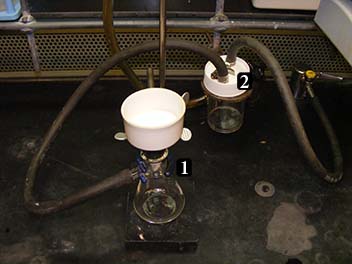
Filtration is a technique used to separate a solid from a liquid and is used in many experiments. Though filtration can be done simply with gravity, more often vacuum filtration is employed because it is much faster. Several points are worth remembering. First, be sure to clamp your filter flask securely. These flasks are easily upended. Use the trap between your filter flask and the aspirator. Also, be sure to use thick-walled vacuum tubing and not the thin walled tubing used for water lines.
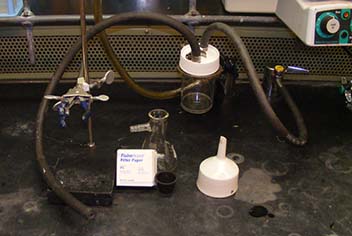
1) Filter flask is secured with a clamp.
2) Thick-walled tubing leads from the filter flask to the vacuum trap..
3) House vacuum valve.
Once your setup is complete, place a piece of filter paper on the filter and wet it with the solvent that you will be pouring through the filter. A mixture of a solid and a liquid can be separated by simply pouring through the filter. Solid that remains in your flask can be further transferred with the aid of a spatula or with a little more solvent.